
Personal Safety & Boundaries
The Free Safe Circle Pack: What You Get and How to Use It With a Child Aged 5 to 10
What is in the six PDFs, how the guides work, and how to start calm conversations with your child.
The free Safe Circle pack is a storybook for children aged 5 to 10, plus five adult guides, sent as six PDFs. First, you read the story together, then choose one or two prompts from the guides, and move on calmly. The whole pack is free to download, as our introduction to Guy & Cesar. It includes a treasure hunt: find the hidden letters together. The child receives a printable certificate from Guy and Cesar, with a space to write their name, and you get 20% off your next book.
Many parents want to talk to their child about safety, feelings and boundaries but are not sure how to begin. So the Safe Circle pack gives you the story to read, the words to say and a simple way to notice how your child responds.
First, this guide explains what is in the Safe Circle pack, who it is for and how to use each part. Then it covers what to do if a child says something serious, and how to get the pack. It draws on the pack itself and on NSPCC guidance, so you can check each point.
What Is in the Free Safe Circle Pack?
The free-pack page says the Safe Circle pack contains a storybook and five toolkit guides, all as PDFs. Also, the six files arrive by email and on your order page.
1
The Safe Circle storybook
The child-facing book for ages 5 to 10, in 11 chapters and a conclusion, with Guy the Guardian Gecko and Cesar the Clever Cat.
2
Adult Companion
Follows the book chapter by chapter and illustration by illustration, with a simple prompt for each one.
3
Observation & Discussion Toolkit
Calm ways to use the book before, during and after reading, with open questions and notes.
4
Red Flags & Risk Indicators Guide
Four categories of indicators for adults, used after the toolkit and only to support reflection.
5
Safeguarding Scorecard
Turns observed indicators into a structured overview, to help decide whether to monitor, support or escalate.
6
Decision & Action Plan
Clear next steps for each colour band, with a record sheet to sign off actions.
Instant download
For example, the bundle page describes the whole Safe Circle pack as an instant download. The free-pack page adds that the download links work for 30 days, so please save your files as soon as they arrive.
Meet the Safe Circle Storybook
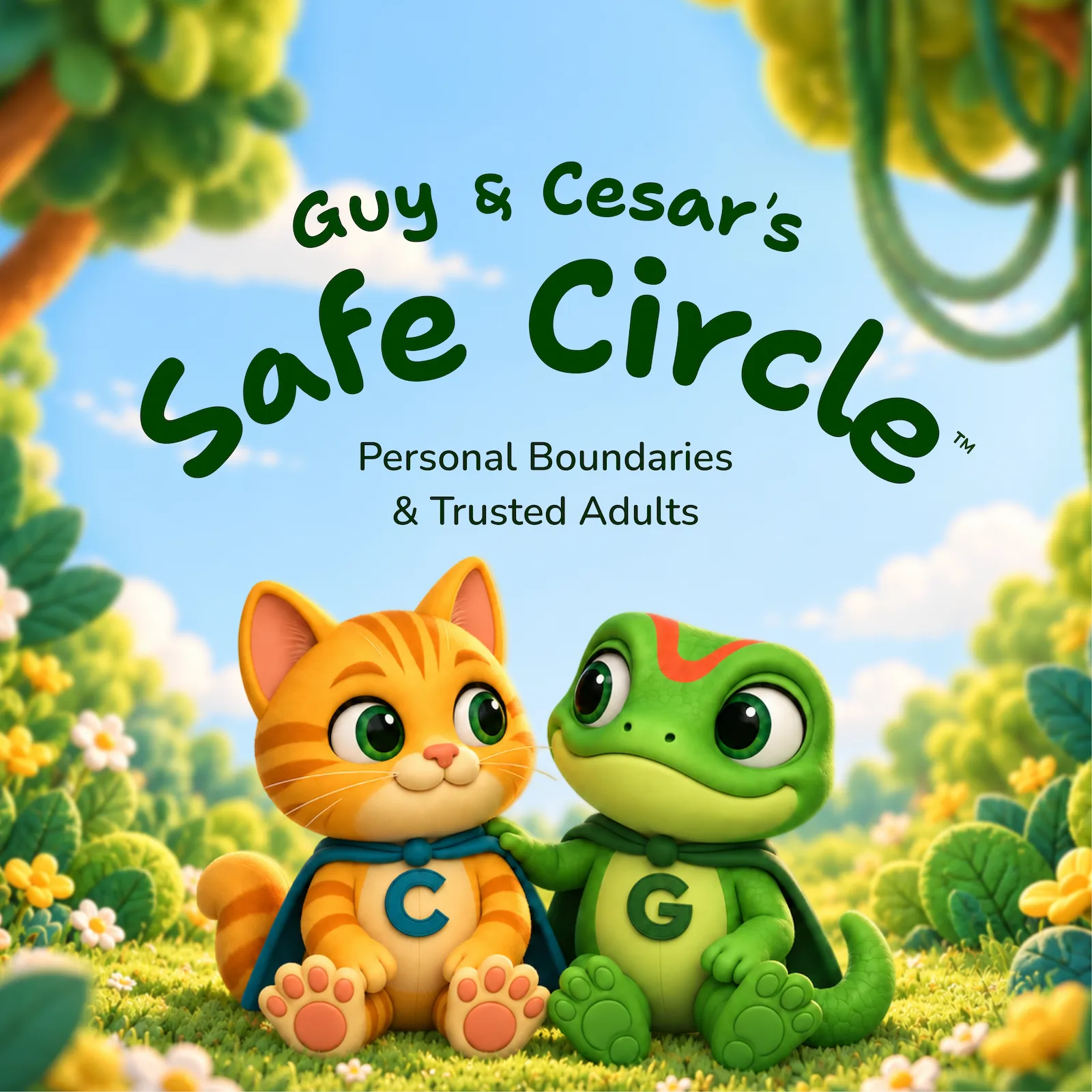
Guy & Cesar’s Safe Circle
The child-facing book in the free Safe Circle pack. Guy the Guardian Gecko and Cesar the Clever Cat guide children from listening to how they feel to saying no, using a safe word and telling a Safe Adult.
Who Is the Safe Circle Pack For?
First, the bundle page says the Safe Circle pack is for parents and carers, foster carers and grandparents, and any caring adult in a child’s life. It also says no specialist training is needed.
In addition, the guides are written so that teachers and other professionals can use them. For example, the Observation & Discussion Toolkit includes a notes log for professional settings, and the Decision & Action Plan has separate notes for home, school and professional settings.
A tool for adults, not a test for children
In fact, the Adult Companion and the toolkit both say the same thing at the start: this resource supports safe conversations, and it is not designed to investigate or question a child. Also, the Adult Companion is for adult use only, so it should not be shared with children.
How Do I Read the Safe Circle Storybook With My Child?
Start with the story. The storybook has 11 chapters and a conclusion, and each chapter is short, so you can read it over several sittings.
- First, Meet Guy & Cesar introduces the Safe Circle idea.
- Then Listening to How We Feel covers comfort, discomfort and body signals.
- Next come the Safe Circle song and Role-Playing Safe Circle, which practise saying no and telling a Safe Adult.
- After that, Safe Words explains how a simple agreed word can help a child ask for help. Our guide on safe and unsafe secrets covers the secrets idea in more detail.
- Building Your Safe Circle, A Day in the Safe Circle and Safe Circles Everywhere link the idea to home, school and out and about.
- Finally, Trusting Yourself and Feeling Safe Together close the story.
Pick a calm time
First, the NSPCC suggests choosing a time when you both have the energy for the conversation, and thinking about whether your child prefers a walk or a private chat at home. Our guide on the best times and places to talk to children about worries and big feelings has more ideas.
Read it more than once
The NSPCC also suggests reading a book about the subject together, then asking gentle questions to check understanding. It says you can read it “a couple of times”. In addition, it suggests several short, bite-sized conversations rather than one long talk, because this gives a child time to process.
How Does the Adult Companion Work?
The Adult Companion follows the book one illustration at a time. First, the pack tells you to read the book with your child, find the same chapter and illustration in the Companion, read the adult prompt, and then move on.
Then, for each illustration, the Companion gives you four things: the child-facing text (exact), an image description for adults only, the understanding element and a simple adult prompt. In addition, the pack describes the whole Companion as easy to use for any adult, regardless of experience or training.
An example
For example, in Chapter 4, one illustration shows Cesar uncomfortable when someone tries to hug her. In the story, the book explains that it is okay to take a step back. The adult prompt for that illustration is: “Let’s practise: what could you say if you don’t want a hug?”
Keep it light
Also, the Companion says to keep it calm and with no pressure. If a child looks worried, stop and reassure them. Our guide on what body safety is and how to teach it explains the ideas behind the hug example. This matches the NSPCC advice that pushing too hard may stress a child so much that they cannot speak.
What Does the Observation and Discussion Toolkit Add?
The toolkit helps you notice how your child responds, and gives you open questions to ask. In short, it is organised around the reading itself.
- Before reading: a quick check-in, such as asking how your child is feeling today, with a short checklist of what you notice.
- During reading: a tick-list of what to watch for, such as engaged, withdrawn or fidgety. However, the toolkit says you are not looking for “proof”. Instead, you are simply noticing.
- After reading: a choice of open questions, with one or two used at a time, and a reassurance close.
- Over time: gentle check-ins on another day, because some children show their feelings later.
The golden rules
Next, the toolkit lists simple do and don’t rules. First, keep it calm, warm and steady. Also, use open questions that start with what, how, who or where, and let the child lead the pace. However, do not ask leading questions, do not press for details, do not show shock or anger and do not promise secrecy.
Similarly, the NSPCC gives matching advice. It says to ask open questions, not to interrupt, and to give your child as long as they need to respond. In addition, for adults who work with children, the NSPCC adds that you should stay neutral and avoid visible shock or embarrassment, which may stop children from sharing.
💚 Want to help your child feel safe telling you things? Read our guide on what a Safe Adult is for children to go further.
What If My Child Says Something Serious?
The toolkit has a section for this. It is for adults and professionals, and it keeps the steps short so you can follow them when you are worried.
- First, stay calm and listen without interrupting.
- Then say, “Thank you for telling me. You did the right thing,” and, “You are not in trouble.”
- Do not promise secrecy. The toolkit suggests saying that you may need to get help to keep them safe.
- Do not question for details. The toolkit suggests one open line only: “Tell me what happened.”
- Then write down the child’s exact words as soon as you can.
- Finally, in a school or professional setting, follow your safeguarding policy and report to the safeguarding lead. In a family setting in the UK, the toolkit says to contact your local authority children’s services, or the police in an emergency.
This also fits the NSPCC guidance for adults who work with children. For example, it says never to promise to keep things secret, and to explain that you must tell people who can help. It also says children should know that Childline offers confidential advice on 0800 1111.
What Are the Red Flags Guide, Scorecard and Action Plan For?
These three guides come after the toolkit, and are for adults who have noticed a pattern. So the pack is clear about the order: complete the toolkit first, then use the Red Flags Guide, and go to the Scorecard only if indicators are present.
Red Flags & Risk Indicators Guide
First, the guide groups indicators into four categories: emotional and behavioural, language and communication, boundary and body-safety, and environmental and context. Also, it says that no single indicator proves harm, and that patterns over time matter more than individual signs. However, it does not diagnose, investigate or confirm abuse.
Safeguarding Scorecard
Next, the scorecard uses a 34-point system across the same four categories. Each indicator is scored 0, 1 or 2, and when you are unsure between two scores, you choose the lower one and keep monitoring. Then the total gives a colour band: green, amber, orange or red.
Decision & Action Plan
The Action Plan then matches each band to next steps. For example, green means monitor and support, while orange means consult your safeguarding lead or an appropriate professional and share documented observations (facts only). Red means follow safeguarding procedures immediately. It also has a sign-off sheet so you can record what you did.
What the pack says about its limits
The pack is careful about this. For example, the scorecard does not diagnose abuse and does not replace professional judgement. Scores are guides, not verdicts. If immediate danger is suspected, the scorecard says to bypass scoring and act, and when in doubt, to seek advice.
How Do I Get the Safe Circle Pack and Share My Thoughts?
First, go to the free Safe Circle pack page and follow the steps there. The page says the whole pack is free to download, as our introduction to Guy & Cesar, and that the free code is applied for you when you add it to your basket.
Then, we would also value your honest review. On the Safe Circle bundle page, you can choose a star rating, write a few lines and add your name. The free-pack page asks for an honest review, good or not so good, and asks reviewers to mention that they received the pack free. The pack is yours either way.
Why the review matters
Because the Safe Circle pack is new, reviews help other parents decide whether it will suit their family. Your feedback also helps us improve the guides.
Common Questions Parents Ask
Is the Safe Circle pack really free?
The free-pack page says the whole pack is free to download, as our introduction to Guy & Cesar. The pack is added to your basket with the free code applied, the total should show nothing to pay, and the six PDFs arrive by email and on your order page. The page also says the download links work for 30 days, so save your files.
What age is the Safe Circle storybook for?
The Safe Circle storybook is written for children aged 5 to 10. In fact, the bundle page describes it that way, with five adult guides to use alongside it. The Adult Companion is for adult use only, so the pack says it should not be shared with children.
Do I need training to use the guides?
The bundle page says no specialist training is needed. Also, the Adult Companion is designed to be easy to use for any adult, with one simple prompt for each illustration. In a school or professional setting, the pack says to follow your own safeguarding policy and report to your safeguarding lead.
Does the Safeguarding Scorecard diagnose abuse?
No. The pack says the scorecard does not diagnose abuse and does not replace professional judgement. Its scores are guides, not verdicts, and patterns over time matter more than totals. If immediate danger is suspected, the scorecard says to bypass scoring and act straight away.
Should I read the whole book in one go?
The pack does not set a time limit. However, the toolkit says to choose only one or two prompts at a time, and to stop if your child looks worried. The NSPCC also suggests several short, bite-sized talks, which gives a child time to process, and reading a book a couple of times.
Where can I leave a review?
On the Safe Circle bundle page, you can choose a star rating, write a few lines and add your name. The free-pack page asks for an honest review, good or not so good, and asks reviewers to mention they received the pack free. The pack is yours either way.
Final Thoughts
In short, the Safe Circle pack gives you a story to read together, the words to say and a calm way to notice how your child responds. You do not need to use every guide, so choose the parts that suit your family.
However, the other guides are there if you need them, and they set out what to do if a child says something serious. So you can start small. Read one chapter, ask one open question and see how your child responds.
If your child finds it hard to put feelings into words, our guide on how to help a child speak up about their feelings may help. Please also check the sources below, and your own school or setting’s safeguarding policy, because guidance can change.
Sources
- Guy & Cesar, Free Safe Circle pack page and Safe Circle Complete Digital Bundle page (accessed 15 October 2026), and the Safe Circle pack files, version 2.0 (2026)
- NSPCC, Talking about difficult topics (accessed 15 October 2026)
- NSPCC Learning, How to have difficult conversations with children, last updated 27 August 2024
Get the Free Safe Circle Pack
A storybook on boundaries for children, plus five toolkit guides for carers. Free to download.